AIM-Linux White Paper
A Unified, Secure, and Hardware-Centric Linux Platform for the AIoT Edge
1. Executive Summary
AIM-Linux is Advantech’s unified embedded Linux platform designed for ARM-based edge devices across NXP, Qualcomm, NVIDIA, and Rockchip ecosystems. Unlike traditional Linux distributions that emphasize containerization or cloud workflows, AIM-Linux focuses on hardware enablement, BSP lifecycle services, and OS-level reliability—the essential foundation required before cloud, AI, or application ecosystems can deliver value.
AIM-Linux addresses key industry challenges:
- Fragmented ARM SoC vendor ecosystems.
- Increasing security and compliance expectations such as CRA, RED, and IEC 62443.
- Lack of documentation consistency.
- Long development cycles for AIoT and embedded products.
AIM-Linux delivers three key pillars:
- Enhanced BSP Launcher and Unified HAL provide a consistent developer experience for BSP creation, flashing, and hardware enablement.
- Standardized documentation framework uses Docusaurus to unify BSP guides, kernel references, pinmux tables, and APIs.
- Industry-aligned value-added services offer prebuilt OS images and SDK bundles optimized for robotics, factory automation, and edge AI.
This foundation enables seamless upper-layer integration with WISE-IoT and WEDA—but only after BSP and OS foundations are properly established, exactly as shown in the AIM-Linux architecture diagram.
2. Introduction
Deploying AIoT and industrial edge solutions on ARM-based hardware typically requires extensive customization across multiple low-level software layers, including bootloaders, kernels, device trees, drivers, and performance or real-time tuning. Each SoC vendor—such as NXP, NVIDIA Jetson, and Rockchip—brings its own toolchains, patchsets, and configuration methodologies. This fragmentation often leads to repeated engineering work, inconsistent system behavior, and longer time-to-market.
To solve this, AIM-Linux introduces a unified software foundation designed specifically for industrial and AIoT workloads. It provides:
- A unified hardware-first architecture that standardizes BSP structures across ARM platforms.
- A consistent BSP service framework covering flashing, diagnostics, provisioning, and peripheral enablement.
- Standardized documentation that ensures predictable learning curves and reduces vendor-specific confusion.
- Cross-platform HAL modules that allow applications to reuse the same APIs across different SoCs.
- Compliance-ready security components, including SBOM generation, CVE scanning, and runtime policy enforcement.
By aligning hardware enablement, BSP management, and security into a coherent framework, AIM-Linux significantly reduces cost, complexity, and long-term maintenance effort while enabling scalable product development across multiple ARM-based product lines.
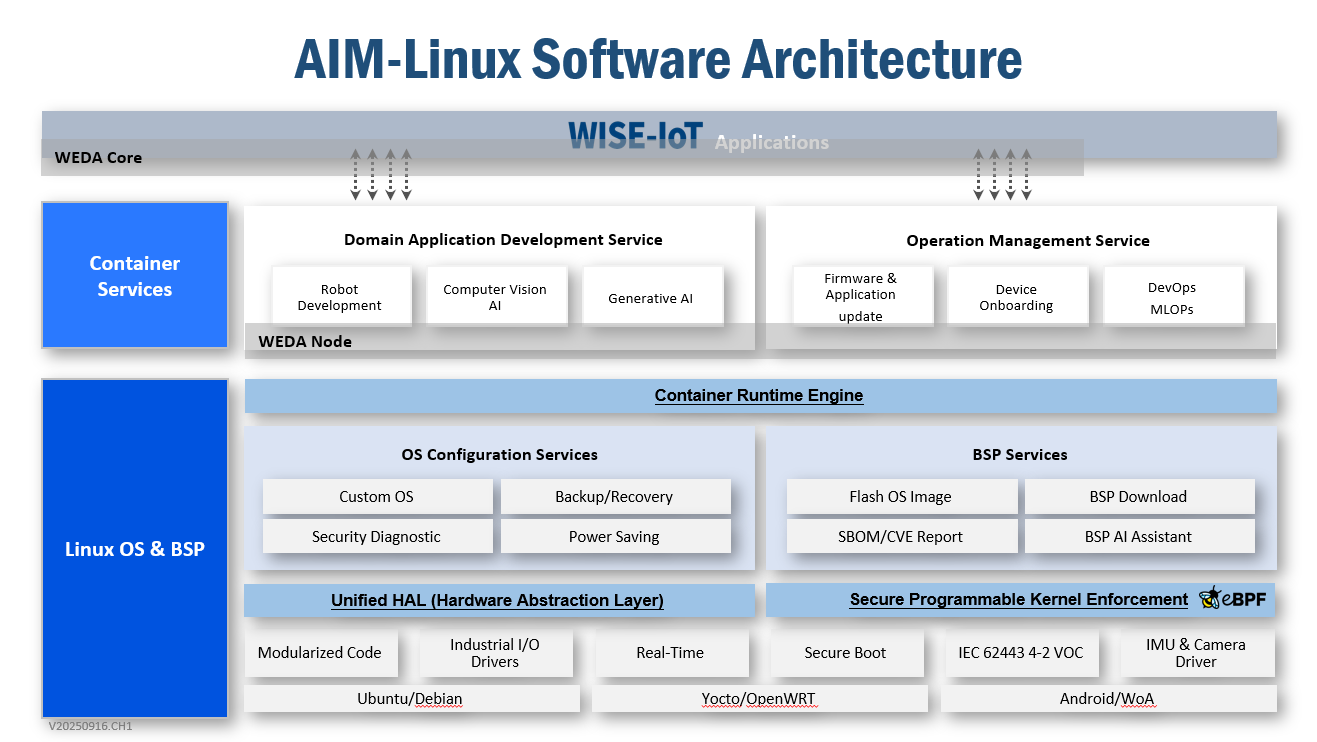
3. AIM-Linux Architecture Overview
AIM-Linux adopts a layered industrial software architecture that ensures consistent behavior across heterogeneous ARM platforms while simplifying customization and long-term maintenance. The architecture is composed of four layers:
- Foundation Layer provides modular BSP, security framework, and driver integration.
- Linux OS Layer delivers BSP Launcher, OS Builder, and PowerSuite for simplified customization.
- Container Services (optional) enable application packaging, deployment, and lifecycle control.
- Cloud Integration Layer connects WISE-IoT or WEDA northbound APIs for device orchestration.
3.1 Foundation Layer (Modular BSP, Security, Driver Integration)
The Foundation Layer provides the essential hardware enablement and security baseline required for industrial ARM platforms. It consolidates hardware abstraction, vendor BSP components, and security controls into a modular framework.
Modular BSP Architecture
- Unified and structured BSP layout across SoCs.
- Standardized bootloader, kernel, and device tree organization.
- Cross-platform build flow compatible with NXP, NVIDIA, Qualcomm, and Rockchip.
- Extensible modules for adding sensor, peripheral, or board variants.
Driver Integration Framework
- Common driver integration pipeline that reduces vendor-specific fragmentation.
- Support for GPIO, I2C, SPI, CAN, UART, PCIe, and MIPI interfaces.
- Industrial I/O and fieldbus extensions.
- Integrated validation suite for driver bring-up.
Security Enforcement
- Secure Boot, measured boot, and hardware root of trust.
- TPM or TEE support for key storage and attestation.
- IEC 62443-ready security primitives.
- Optional eBPF-based runtime security, including syscall policy enforcement, network event filtering, and behavioral anomaly detection.
3.2 Linux OS Layer (Customization Made Simple)
The Linux OS Layer focuses on enabling rapid OS customization using well-structured tooling that abstracts BSP complexity. AIM-Linux ensures that OEMs and solution developers can configure, tune, and deploy their OS images with minimal engineering effort.
BSP Launcher
- One unified entry point to build, flash, validate, and publish BSP packages.
- Auto-detection of target SoC and board profiles.
- Integrated dependency management and build orchestration.
OS Builder
- Template-based OS configuration for Ubuntu, Yocto, or Debian.
- Kernel config presets for AI, real-time, and industrial workloads.
- Image composition tools for enabling or disabling subsystems such as networking, graphics, or AI accelerators.
- Built-in SBOM and CVE generation pipelines.
PowerSuite
- Power mode optimization for performance, balanced, or low-power profiles.
- Dynamic CPU, GPU, or NPU throttling framework.
- Suspend or resume behavior tuning and debugging tools.
- Thermal-aware governor configurations.
Outcome of the Two Layers Working Together
When combined, the Foundation Layer and Linux OS Layer provide faster bring-up of new boards and SoCs, repeatable OS image generation, reduced dependency on vendor-specific BSP tooling, security-by-default with industrial-grade enforcement, and predictable, scalable product development across multiple hardware lines. This structured architecture minimizes engineering overhead while maximizing long-term maintainability.
3.3 Container Services (Optional)
Although AIM-Linux is primarily focused on BSP and OS foundations, it optionally supports container services that align with the WEDA Node or Core architecture. These services enable domain-specific workloads and lifecycle management without replacing the responsibilities of the BSP and OS layers.
Domain application development
- Robotics workloads, including ROS-based or real-time robotics applications.
- Computer vision AI inference supported through frameworks enabled by WEDA Edge.
- Generative AI pipelines, LLM-based agents, and model execution at the edge.
Operation management
- Automated device onboarding via WEDA Node.
- Secure OTA update mechanisms for OS images and containers.
- CI or CD and MLOps pipelines for workload deployment, model updates, and rollback strategies through WEDA Core APIs.
These container-related capabilities are optional extensions that complement the foundational system layers while enabling scalable application deployment on AIM-Linux-powered devices.
3.4 Cloud Integration Layer
AIM-Linux integrates with Advantech WEDA to deliver cloud-level device management, telemetry, and remote orchestration once the BSP and OS layers are established.
Standard APIs and device management
Through WEDA Core’s RESTful API set, AIM-Linux devices can be remotely configured, provisioned, and maintained. WEDA Node maintains a synchronized digital twin for each device, enabling reconciliation between desired and reported states.
Telemetry and health monitoring
Devices continuously report metrics such as CPU load, temperature, and resource utilization. These metrics populate the digital-twin shadow, enabling predictive maintenance, anomaly detection, and long-term fleet analysis.
Remote diagnostics and operations
WEDA provides virtual TCP tunnels for secure remote access, allowing configuration, debugging, and diagnostics without physical on-site access or VPN. Container lifecycle management—start, stop, update, rollback—and AI model deployment can all be orchestrated via WEDA Core APIs.
The cloud integration layer transforms AIM-Linux systems into fully managed, observable, and updatable nodes within a distributed industrial network, enabling scalable remote operations and lifecycle governance.
4. Developer Tools and Standardized Documentation
AIM-Linux provides a comprehensive developer ecosystem supported by unified documentation, consistent tooling, and a platform designed to reduce fragmentation across ARM-based AIoT development. Its documentation system is built using Docusaurus, enabling a version-controlled, searchable, and developer-friendly portal that ensures consistency across SoCs and product generations.
4.1 Documentation Structure
The AIM-Linux documentation portal provides a consistent and comprehensive structure, including:
- BSP manuals cover BSP architecture, supported SoCs, hardware enablement layers, and lifecycle operations.
- Bootloader and kernel notes highlight U-Boot configuration, kernel patching, DTS customization, version strategy, and performance optimization.
- Pinmux and I/O mapping guides provide complete references for pin configuration, hardware interface mappings, and design best practices.
- HAL API references list official API specifications for AIM-Linux’s unified Hardware Abstraction Layer across I/O access, camera subsystems, multimedia pipelines, accelerators, and connectivity.
- Security policy and configuration manuals document Secure Boot, Root of Trust, eBPF policies, TPM or TEE integration, user authentication, access control, and IEC 62443 compliance features.
- Build and flash instructions offer step-by-step guidance for building AIM-Linux images, generating bootable media, and flashing devices across ARM platforms.
- Troubleshooting and developer FAQs capture common issue resolutions, debugging patterns, logs, and recommended diagnostics tools.
4.2 Developer Tools and Portal Benefits
The AIM-Linux documentation and tool ecosystem provides significant benefits for engineers and solution developers:
- Unified documentation framework across all ARM platforms reduces fragmentation and learning overhead.
- Markdown-based, version-controlled content keeps revisions aligned with BSP versions, kernel releases, and LTS updates.
- Searchable and cross-linked topics enable quick access to related materials such as API references, BSP notes, and troubleshooting guides.
- Content is optimized for firmware engineers, system integrators, and customer-facing technical staff.
- Documentation aligns with AIM-Linux development flows, including BSP Launcher or Builder workflows, HAL usage, flashing tools, and debug utilities.
5. AIM-Linux Services
Advantech provides a unique, standardized “Design-In Service” platform through AIM-Linux. This service model ensures consistency, reliability, and scalability across all customer projects—from early evaluation to mass deployment—enabling faster integration and long-term product lifecycle stability.
5.1 BSP Enablement Services
Advantech’s Design-In Service ensures every BSP is production-ready, well-maintained, and optimized for long-term support.
- Board bring-up and hardware validation.
- Peripheral and device driver development.
- Kernel customization and patch integration.
- Automated regression and stability testing.
- Standardized BSP release and maintenance cycles.
- Long-term support across product lifecycles.
This standardized BSP workflow enables predictable quality and reduces engineering overhead for customers.
5.2 Compliance and Certification Services
AIM-Linux integrates Advantech’s professional compliance service framework, ensuring products meet modern cybersecurity and regulatory requirements.
- IEC 62443 VOC (Verification of Conformity) support.
- RED cybersecurity testing and documentation.
- CVE tracking, patching, and lifecycle management.
- Security hardening guidance for production environments.
These services ensure customers can confidently deploy AIM-Linux in safety-critical and security-regulated industries.
5.3 Industry-Aligned Value-Added Services
Advantech offers pre-validated and optimized OS images tailored for major industrial application domains. These images follow a standardized, tested configuration baseline, reducing customer integration time and risk.
Optimized AIM-Linux images for:
- Industrial vision and AI inspection.
- Robotics or AMR platforms.
- Smart retail and video analytics.
- Transportation, edge gateways, and infrastructure.
These solutions provide faster time-to-deployment, reduced compatibility issues, and field-proven configurations validated by Advantech engineering. AIM-Linux thus becomes a ready-to-integrate, production-grade platform that accelerates customer project success across multiple industries.
6. AIM-Linux Applications and Conclusion
AIM-Linux is Advantech’s hardware-centric, secure, and scalable Linux platform for ARM-based edge devices. Built on Advantech’s standardized products, it provides a stable foundation for diverse applications and long-term maintainability.
6.1 Typical Use Cases
- Industrial vision supports multi-camera pipelines, real-time AI inference, and secure OTA updates.
- Robotics or AMR leverage ROS 2 real-time control, sensor fusion, and deterministic control.
- Smart retail uses computer vision for customer analytics, on-device AI inference, and remote management.
- Edge gateways benefit from multi-SoC BSP compatibility, Secure Boot and SBOM, and long-term maintainability.
6.2 Key Advantages
- Unified HAL simplifies cross-product development with a consistent hardware abstraction layer.
- BSP-first architecture ensures hardware stability as the core of system design.
- Standardized documentation provides complete and traceable technical references.
- Domain-specific services offer optimized support tailored to different industries.
AIM-Linux bridges the gap between hardware enablement and cloud applications, empowering developers, integrators, and solution providers to accelerate time-to-market with confidence. Based on Advantech’s standardized product design, AIM-Linux delivers a reliable application foundation that enables AIoT innovation and long-term product success across multiple domains.